
Stage one: finding out what is under there
Before a price means anything, someone has to know what the first spade turns up. On the Central Coast that is a genuinely open question in a way it is not in most markets, because the NSW soil landscape mapping shows the region is not one thing.
Umina Beach maps as 24.7 per cent Disturbed Terrain, which is the mapping term for artificial fill. The unit report describes it as "unconsolidated low wet bearing strength materials, impermeable soils, poor drainage", with surface movement "highly variable, depending on materials and degree of compaction". A quarter of that suburb is, in the literal sense, unknown until excavation. Woy Woy is a different flavour of the same warning: seventeen mapped units across two map sheets with no single unit above 17 per cent, on a suburb polygon that is only 86.7 per cent mapped at all. A site check there is not a disclaimer, it is the answer.
Contrast that with Wyoming, mapped at 100 per cent coverage as 56.8 per cent Erina and 32.2 per cent Watagan. That is predictable ground with predictable problems: reactive subsoil, slope, and shallow rock in places, since the Watagan report notes "Total soil depth varies considerably from <50-200 cm".
Indicative laid rates, by quality tier
| Tier | Supply only ($/m²) | Supplied & installed ($/m²) | Typical lifespan |
|---|---|---|---|
| Budget | $25–40 | $75–95 | 5–8 years |
| Mid | $40–60 | $95–130 | 10–15 years |
| Premium | $60–100+ | $130–160+ | 15–20+ years |
Supply-only and supplied-and-laid $/m² bands from published 2025-26 Australian supplier and industry pricing. Not a quote: the real figure comes from a site visit.
Stage two: excavation, and where the money starts
The existing lawn, roots and topsoil come out to roughly 75mm, closer to 100mm anywhere a vehicle will drive. Irrigation heads inside the area are capped rather than buried live, which is a small detail that saves an expensive afternoon later.
Two Central Coast things change this stage. The first is access. Everything comes in by the tonne and everything goes out by the barrow-load if there is no vehicle route, and older peninsula blocks and hillside houses above Gosford are both places where there often is not. The second is what excavation exposes. On fill, the crew may find a base that needs deeper removal and replacement than the quote assumed, which is precisely why the quote should say what happens to the price if it does.
Stage three: the base, built two different ways
This is the 30 per cent of the job you pay for and never see, and on this coast it is genuinely built differently depending on which suburb you are in.
On the sand. Umina Beach, Ettalong Beach and parts of Woy Woy sit largely on the Woy Woy unit, "deep (>200 cm) Siliceous Sands" that the Sydney sheet records with the "Watertable at a depth of <200 cm" and "permanently high watertables". Drainage capacity is not the constraint. Stability is. The report's own line is that the "poorly sorted unconsolidated sands may require compaction, and shoring of foundations may be required". A base here is about compaction discipline and edge restraint, and about not building down so far that you meet groundwater.
On the clay hills. Erina, East Gosford, Kincumber, Copacabana, Avoca Beach and Wyoming are dominated by the Erina unit, rated "a moderate to high foundation hazard" with "seasonal waterlogging of footslopes" and subsoil limitations including "Low permeability", plus the steeper Watagan unit at "High foundation hazard" with "steep slopes". Here the base is a drainage structure. It needs enough depth of free-draining crushed rock, graded to a deliberate fall, to carry water sideways to a point where it can leave, because it is not going down through that subsoil in any hurry.
Both versions get road base wetted and plate compacted, a screeded layer of crusher dust or screenings over it, and a second compaction pass. What differs is the depth, the fall design and where the water is aimed.
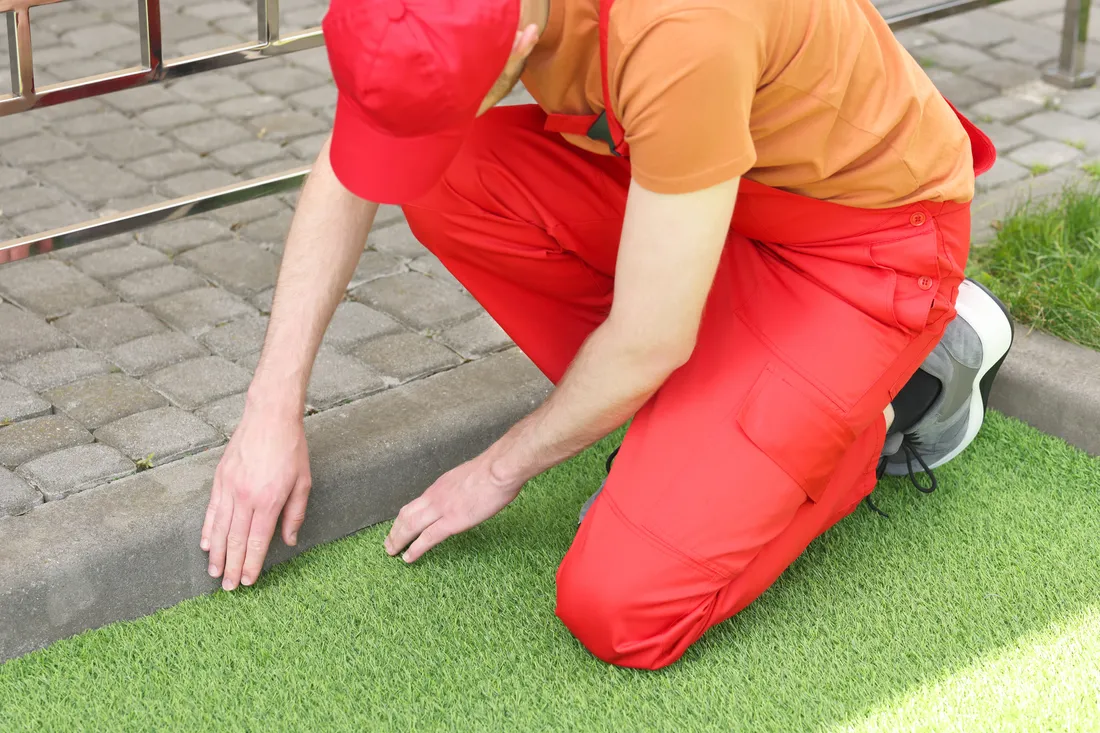
Stage four: laying, joining and finishing
- Relax and set out. Rolls are laid out to settle before cutting. Synthetic fibre has a grain and leans one way, so the lawn reads a different shade from different angles. Every piece must run the same direction or the joins draw themselves in contrasting tone.
- Joins. Edges are trimmed back a couple of stitch lines to remove the factory selvedge, pieces are butted rather than overlapped, and synthetic joining tape with adhesive holds them from below with fibres kept clear of the glue. Blades get changed constantly, because a blunt knife tears backing.
- Fixing. Perimeters are pinned at roughly 300 to 400mm into a prepared edge. Where turf meets concrete or pavers, adhesive does the work instead, usually over a foam underlay of around 5mm.
- Infill. Kiln-dried silica sand at about 10 to 15 kilograms per square metre, power-broomed in. It ballasts the lawn, stands the fibres up, shields the backing from UV and hides the joins. Under-sanding looks perfect on handover day and matted by the next summer.
Rough out your own total
Enter your approximate lawn area to see a supplied-and-installed price range. This is a planning estimate built from published Australian supplier pricing. Your installer will confirm an exact quote after measuring your yard.
Laying turf against re-turfing properly
The fair comparison is not synthetic turf against the tired lawn you have, it is synthetic turf against doing the natural version properly. Both jobs start identically: strip, prepare, level. The difference is everything after the last roll.
A new natural lawn has to be watered in hard. Central Coast Council allows exactly that: "If you are establishing a new lawn, you may use sprinklers and watering systems as needed for 14 days from the date of installation", and no application is required. On day 15 the ordinary Water Wise Rules resume, meaning garden watering before 10am and after 4pm, for the rest of the lawn's life. That is a modest constraint and we are not going to inflate it. The Central Coast is not under water restrictions; Council states plainly that "Water Wise Rules are not water restrictions" and that restrictions would only begin if Mangrove Creek Dam reached 50 per cent.
So the water argument here is real but small: the bill you stop paying and the watering window you stop planning around, not an escape from rationing. The stronger arguments on this coast are elsewhere, in maintenance time on a property you are not always at, and in a surface that does not turn to mud on a clay footslope after a 143.8 mm June.
Be careful with the ten-year comparisons circulating online. Australian suppliers publish figures putting a decade of natural lawn maintenance near $20,000 against $3,000 to $5,000 for a comparable artificial lawn, while CHOICE notes the up-front artificial cost is roughly double the natural establishment cost. Both are true statements about different things. Do not blend them into one number, and note the environmental trade-off honestly too: recycling pathways exist in Australia, but CHOICE has flagged a larger lifecycle carbon footprint than natural grass and up to 60 per cent higher runoff.
Questions about laying artificial grass here
What does it cost to lay artificial grass per square metre on the Central Coast?
Supplied and laid, the published Australian bands are roughly $75 to $95 for budget product, $95 to $130 for mid range and $130 to $160 or more for premium. Most standard residential jobs here land in the $90 to $130 band. Those are budgeting figures compiled from supplier and industry pricing, not a quote for your yard.
Why is the laid price so much higher than the supply price?
Because the grass is a minority of the job. Industry figures split a residential install at roughly 40 per cent materials, 30 per cent base preparation and 30 per cent labour. Buying budget turf at $25 to $40 per square metre and seeing it laid at $75 to $95 is not a markup on the roll, it is excavation, road base, screenings, compaction plant, edging, infill and hours.
Can I lay it over the existing lawn to save on excavation?
It is the single most common shortcut and it is the one that fails. Organic material under the turf keeps breaking down, so the surface subsides unevenly, and the old root zone holds water rather than passing it on. The excavation is not there to make the job look thorough. It is there so the layer under your lawn is one you chose.
Does the peninsula sand mean I can skip the base?
No, and it is a tempting mistake. The Woy Woy soil landscape report describes sand that drains freely but notes the "poorly sorted unconsolidated sands may require compaction" and lists "soils with low wet bearing strength" and "fluctuating high watertables". Sand does not need help draining. It needs help holding a shape and staying above the water underneath it.
What happens to the excavated soil?
It leaves the property, and on a tight block that is a real line rather than a rounding error. A standard lawn is dug to about 75mm, more under vehicle loads, and that volume of turf, roots and topsoil has to get from the backyard to a truck. If the route is a 900mm side gate and a barrow run, the hours climb. Ask how spoil is priced and whether tipping is included.
Do I need council approval to lay it in my own backyard?
Not normally. The rules that exist in Australian councils apply to the verge or nature strip, which is public land, rather than to private yards. Central Coast Council publishes no position on synthetic turf on the nature strip either way, but works on the verge generally require council approval under the Roads Act 1993 and the Local Government Act 1993, so check with Council before any part of the job crosses your front boundary.
How long will a properly laid lawn last?
Australian sources genuinely disagree, so the honest answer is a range with attribution. Supplier tier guides say 5 to 8 years for budget, 10 to 15 for mid and 15 to 20 or more for premium, while CHOICE has said a well-maintained premium lawn can reach up to 25 years. Warranties commonly sit in an 8 to 15 year band and typically cover UV fade and fibre loss rather than base failure. That exclusion is worth reading twice: the part most likely to fail early is the part the warranty will not cover.
Is it worth paying for a second compaction pass?
You should not have to pay extra for it, because it is standard practice. Base material is compacted at least twice and made as hard as it practically can be. If a quote is notably cheap, this is one of the two places the saving usually came from, the other being falls. Both take about a season to reveal themselves and are impossible to inspect afterwards.
Find out what your yard would actually cost
Send the rough size and the access situation. One vetted local installer confirms a firm price after seeing the space, and there is no obligation.
Get a free, no-obligation quote
Tell us a little about your job and we'll pass it to a vetted local installer.