
Shorter, denser pile
Pet-grade product typically sits around 20 to 35mm rather than the 30 to 45mm used for a show lawn. Shorter fibre traps less and brushes clean faster.
Pet-grade product typically sits around 20 to 35mm rather than the 30 to 45mm used for a show lawn. Shorter fibre traps less and brushes clean faster.
PU absorbs less moisture and handles heat better than latex, which trade guidance says ages more rapidly in hot, humid conditions. On a humid coastal block that matters.
The standard Australian pet infill. It absorbs ammonia from urine before it reaches the backing, which is where odour otherwise settles in.
Australian supply specs put minimum drainage around 30 litres per square metre per hour. The surface is rarely the limit. Where the liquid goes below it is the whole job.
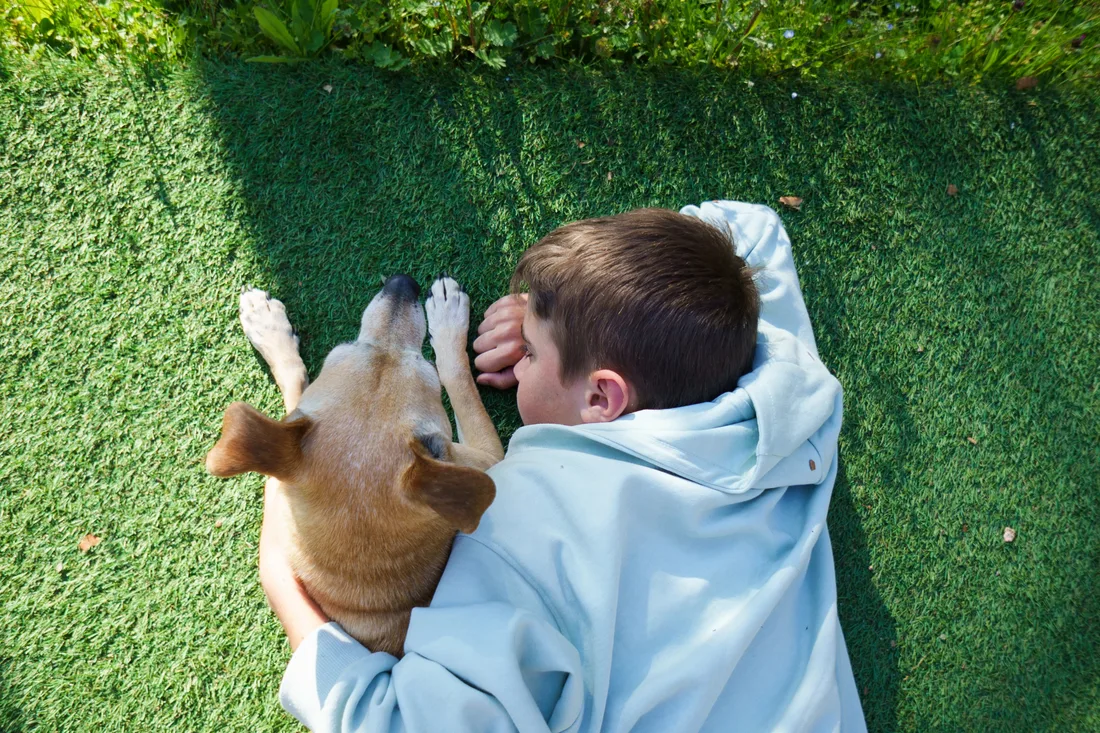
Every pet turf failure we can find described in Australian material traces back to liquid that could not get away, and the surface is almost never the culprit. Turf is specified to pass around 30 litres per square metre per hour as a minimum, which no dog can outproduce. What matters is the layer beneath.
On the Central Coast that layer is two different problems depending on where you live. On the peninsula, the Woy Woy unit is deep sand, so downward drainage is easy, but the same NSW reports record "permanently high watertables" and a watertable "at a depth of <200 cm". A base built without regard to that can saturate from underneath during a wet stretch, and Norah Head AWS records 1215.2 mm of rain a year with June its wettest month at 143.8 mm.
In the hill suburbs the problem inverts. Erina, which dominates Erina, Kincumber, Avoca Beach, Copacabana, East Gosford and Wyoming, is rated "a moderate to high foundation hazard" with "seasonal waterlogging of footslopes" and subsoil limitations that include "Low permeability". There, liquid has to be moved sideways on a deliberate fall to somewhere it can leave. A dog run built flat on clay is a smell waiting for summer. More on both in the sand and watertable guide.
Nobody selling turf enjoys writing this section, so here it is in full. Solids get picked up daily, the same as on grass. Urine zones get a rinse after use, which on a hot day doubles as cooling the surface. High-traffic areas get an enzyme cleaner roughly weekly, because enzymes break down uric acid where detergent only moves it around. A half-and-half vinegar and water spray, left 15 to 20 minutes, brushed and rinsed, is the common household deodoriser. Beyond that, the general turf routine applies: brush the pile monthly in alternating directions to keep the fibres upright, clear leaves weekly so drainage is not blocked, and treat moss or weeds around the perimeter about once a year.
That is a real commitment, and it is still considerably less work than mowing, watering, patching and fertilising. But a page that told you a pet lawn cleans itself would be lying to you, and you would find out in about six weeks.
Rinsing a pet lawn is garden watering under Central Coast Council's Water Wise Rules, which apply all year and, in Council's own words, "are not water restrictions". Watering with a sprinkler, irrigation system or a hand-held hose fitted with a trigger nozzle is permitted any day before 10am and after 4pm. Hosing paths and driveways is out. Council asks households to aim at a target of no more than 150 litres per person per day, which is a target rather than a limit anyone enforces against you.
Practically, a hose-down of a dog zone is a few litres and takes seconds, and the times you most want to do it (early morning, late afternoon) sit inside the window anyway. It is a smaller consideration than the marketing in this industry usually suggests.
Independent consumer body CHOICE says yes, with two conditions attached: drainage has to be installed properly, and you have to be willing to keep up a cleaning routine. That is a fair summary and we would not put it more strongly. A pet lawn is low maintenance compared with grass, not no maintenance.
It will if the base drains poorly or if solids are left to break down in the pile, and it largely will not if neither happens. Urine passes through a permeable backing; ammonia is what lingers, which is why zeolite infill is the Australian standard for pet installs. The routine that keeps it honest is solids picked up daily, urine zones hosed after use, and an enzyme cleaner across high-traffic areas about weekly.
A determined digger will find the edges, which is why edge restraint and fixing detail matter more on a pet job than on a lawn. Perimeters pinned at roughly 300 to 400mm intervals into a properly prepared edge, or bonded where turf meets concrete, are the difference between an annoyance and a repair. Talk to the installer about the specific dog rather than about dogs in general.
Yes, and for reasons you can see on the invoice. Australian supplier pricing puts pet-grade installs at roughly $100 to $145 per square metre against $85 to $140 for a standard residential lawn. The gap is the denser product, the PU backing and the zeolite, which is a separate infill to the standard kiln-dried sand rather than a substitute for it.
It helps and it is not the whole story. The Woy Woy soil landscape underlying Umina Beach and Ettalong Beach is described as deep siliceous sand, which soaks water away readily, but the same reports list "permanently high watertables" and put the watertable "at a depth of <200 cm". Free-draining ground with water underneath it is still ground that can saturate from below in a wet week. The base needs to be built for that, not just for the sand.
Hotter than grass, and this is the honest limit of the product. Western Sydney University researcher Dr Sebastian Pfautsch has reported unshaded synthetic turf reaching surface temperatures far above natural lawn, including on days that were not extreme. Norah Head AWS puts the January mean maximum at 26.4C, which is mild by Australian standards, but a fully exposed north-west facing run will still be uncomfortable at times. Shade over part of the run, lighter yarn and a hose within reach are the practical answers. Suppliers who advertise cooling yarns or evaporative infills may well be right, but those percentages are their own claims and are not independently verified, so ask for the data.
That is a different brief again, because nobody is on site between guests to notice a problem building. We wrote a separate guide on it: pet-friendly short-stay turf needs the drainage of a pet job and the cleaning tolerance of a commercial one, since the person who lets the dog out will not be the person who cleans up.
Tell us the rough area and the dog, and a vetted local installer will price it properly. Free, no obligation.
Tell us a little about your job and we'll pass it to a vetted local installer.